
life-threatening
at what point are they killing the tumor, and at what point are they killing you?

Michael had cancer. The life-threatening kind (he corrected me when I called it terminal). The distinction mattered to him. I understood.
He called cancer an ironic disease. It is. It’s a natural process – cell growth, how your body heals itself – going into overdrive and destroying you. Survival instincts that become self-destructive.
Michael had stopped chemo. It was barbaric, he said. I found that to be interesting. Barbaric is the word I use in the privacy of my own head, too. They give you poison to kill the tumor inside you and hope you’re not too badly harmed in the process.
At what point are they killing the tumor, and at what point are they killing you?
Michael’s sentences wandered. Hospice to his oncologist to racism to fuzzy kitties to childhood trauma to mushrooms to crying to describing the friends he was staying with. Occasionally, he’d sit in silence. I was struck by his refusal to edit the movement of his mind.
I told Michael I worked in healthcare. I have a chronic illness. Not the same as cancer, of course, but I know what it’s like to be sick. To navigate the frontiers where the healthcare system runs out of help.
I talked about step therapy – how insurance requires patients to fail the cheaper medications before it’ll approve the ones that might actually work. And prior authorization, where a request for treatment gets filed, denied, appealed, denied again, and somewhere in that cycle a body is deteriorating.
That morning, I’d shadowed a nurse making calls to check in on recently hospitalized patients. During one of the calls, a patient’s son informed her they had put their father into hospice care. She didn’t react. She merely clicked around in her medical record to unenroll the patient from her program. She had eight other patients to call. I watched her dial the next number. Later, I retreated to the bathroom to compose myself.
Michael watched me with a half-smile on his face. “You’re very good at making it make sense. I’m curious what would happen if you bring more of your heart to your work. To me, that feels endlessly valuable.”
I’m eleven years old and I’ve had a 104-degree fever every night for months. We don’t know what’s wrong with my body. We won’t know for another two years.
So I get smart. When it takes 4 months to schedule an appointment with an infectious disease specialist, I learn about AMA lobbying that limits the number of doctors in the workforce. When I finally get a diagnosis, I pirate an immunology textbook from a shady Russian website and read it on my iPad every night before bed. When my medication gets denied by my insurance, I skip all of my college classes and watch videos about pharmacy benefits managers and their economic incentives.
You can predict everything the American healthcare system will do if you follow the money. So I learn about the money.
It takes four months before I get the first dose of that medication. It’s the first time I come out of remission in 8 years.
I’m twenty-five now. I track my own labs. I justify my own prior authorizations. I keep up with all my labs and preventive screenings and appointments. Doctors constantly tell me I’m a “good patient.” I make their jobs easier.
I work in healthcare. Healthcare finance, more specifically. I love my job. I love the people I work with, the creativity and the dynamism and the chaos and the aliveness.
I’m following the money. I help hospitals see their numbers clearly. Somewhere inside those numbers, there are people just like me. Sometimes I can’t tell whether I’m fixing the system or perpetuating it.
I wake up. It’s Saturday morning. My friend’s birthday party is later that afternoon, and I’ve been looking forward to it all month. I reach over to grab my phone. Something seismic shifts along my spine. This again.
Eventually, the burn of defiance forces me upright. I get dressed. I put on three-inch heeled boots. I’ll be overdressed, but they brace my back just enough to make the pain a little more bearable.
I show up. I squeeze everyone tightly. We run through the life updates. I spit my water on someone from laughing too hard. I help to start a dance circle and we run through some old choreography, just like the old days. My friend calls me the life of the party. It’s nice of him to say.
I come home. I sit on my bed. I start replaying the day. I hate it all. What? My immune system? Myself? The fact that I was in my pain? That I spent the entire day pretending it didn’t exist? For wanting someone to understand, to acknowledge the cost? For being too much? For not being enough?
My skin is burning. My room is too quiet. I feel my pulse everywhere. I resent them all for their health. I hate myself for the weakness of that thought. I hate my body for being weak. I hate that I’m so good at hiding it.
And I feel myself starting to explain it. I showed up because I care an unreasonable amount about birthdays (I almost didn’t get my 13th). Some part of me didn’t want to be alone with my thoughts, that’s the only thing worse than the physical pain. I can tell you exactly what I ate yesterday that caused my current flare, and I should have known better because I know all about what’s wrong with my intestinal epithelial cells and interleukin-23, I know that autoimmunity is–
I can understand everything and I’ll still come home and sit on my bed alone and in pain, hating myself and not knowing why I do.
The human immune system has spent millions of years learning how to keep us alive. It maintains a library of every threat encountered, every virus, every bacterium, every pathogen. It builds precise, targeted defenses against invaders, and when the threat is gone, it keeps the record, so next time, it can respond faster, harder, better. It is an extraordinarily sophisticated and devoted system, engineered to defend you from anything and everything that could hurt you.
At some point, the system has been on high alert for so long that threat becomes the only thing it knows how to see. And then, because it is so good at what it does – because it has spent millennia training to fight – it wages a precise and devastating campaign against the very thing it has spent millions of years trying to protect.
We who have lived inside unreliable bodies learn to hurry. We hurry because we learn that time is conditional. We learn to read every signal our bodies send, to advocate for ourselves in a system that sometimes fails to see our needs. We build libraries so we can watch out for the next thing that might hurt us.
I come home from the party and prosecute myself. I think about my eulogy more than I’d like to admit. On my walks home from work, I’ll think about the paper I haven’t written, the policy I haven’t shaped, the company I haven’t built, the friend I haven’t called.
If I weren’t sick, would I still be this afraid of wasting a day? Would I work as hard, would I care as deeply?
“I fucking love duality,” Michael told me at one point. “Most people spend their lives running from that in-between space, but that’s where everything real happens.”
He was describing it all – his panic, anger, fear, resentment, heartbreak, the okay-ness. He didn’t call it acceptance or peace. At one point, he let a few tears fall.
I wish I could say I was inspired by Michael, as unedited and unfiltered and present and alive as he was. I wasn’t. Michael was running out of time, and he wasn’t at war with himself, and a large part of me envied how simple he made it seem. To just be.
I haven’t been afraid of death in a long time. I’m more afraid I’ll spend my whole life trying to make it all mean something and forget to actually live it.
My body has been attacking itself and it’s been fourteen years – more than half of my life now – and I don’t know, it feels like failure and betrayal all at once. But somehow I’m still here, and there’s a fire in my chest telling me that it’s my life’s mission to make healthcare better for other patients – how? i have no idea – and that’s daunting but I can’t imagine doing anything more fulfilling… and every once in a while I dream about how my parents’ faces looked when my doctors started using words like “feeding tubes” and “comfort care” oof there’s always so much to do, doctors appointments, insurance calls, medication refills, cancer checks and look, I know my situation isn’t that bad – it’s not that bad – but sometimes it’s so, so hard and knowing why the prior auth got denied has never made it hurt less.
I don’t know if I work in healthcare because I care about these problems or because I want to do something meaningful with my life or because I love the people who work in this industry or because I’m selfish and I know that inevitably one day I’ll be sick and it would be nice for the next time to go better than all the times before or because every time I go to the doctor and they tell me that med number four, five, six, seven – we’ve lost count now – isn’t helping anymore and we’ll need to find a new one… I... when they say that, it feels like I’ve failed – failed what? i don’t know – and maybe when that happens I need something that helps me feel like I have control.
Maybe the whole career, the whole life, even this essay is just the most sophisticated version of a girl in a waiting room, fourteen years later, telling herself if she understands the world well enough it can’t fail her again.
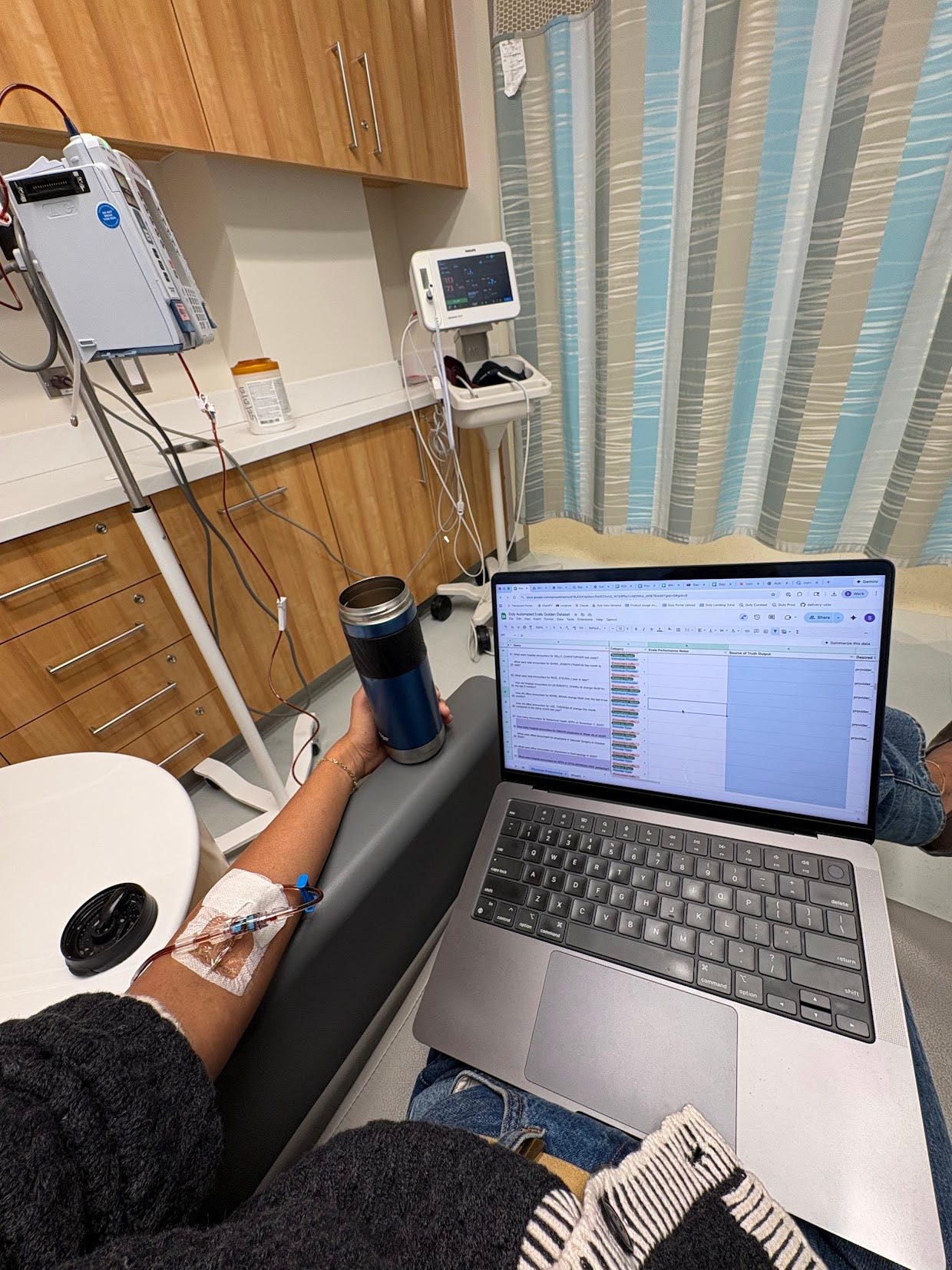
update:
I put an earlier version of this reflection on the internet in April 2025 for literally anyone to read, but I was terrified to share it with Michael. I held onto his email address for many months, telling myself I’d send it to him later, and then – when I’d almost forgotten about it entirely – I decided to email him.
He responded four hours later. He mentioned fuzzy kitties. That was ten days before he passed away.
this is refreshing emotional and moving beyond any words i could use to explain. thank you for writing this
🫶